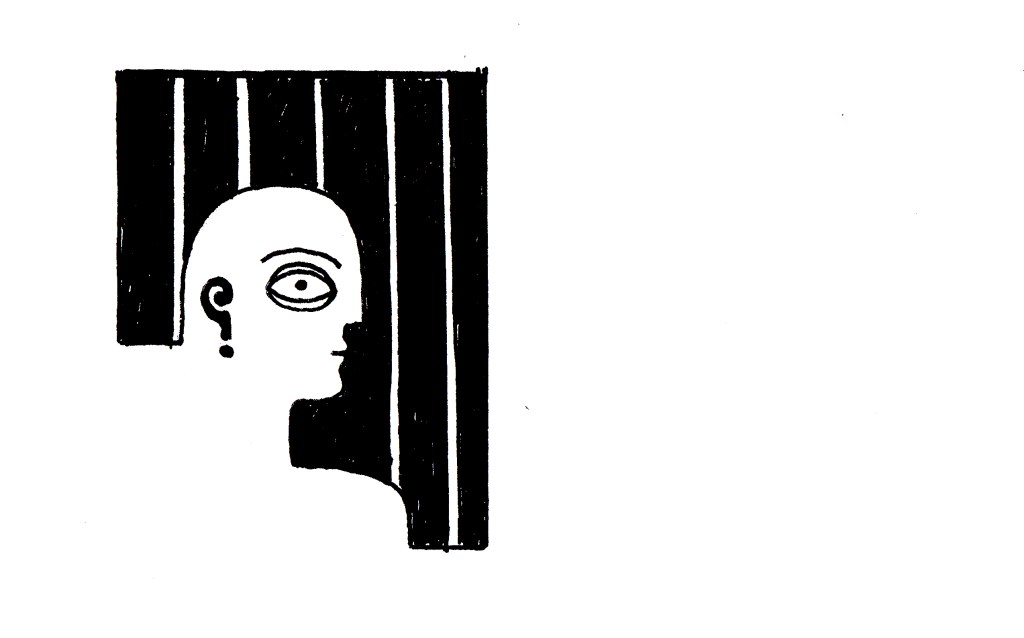
I Sayed
Her son, me, he lives twelve thousand eight hundred and ninety-
seven kilometers away, in Turtle Island.
Sometimes she wakes up at night and glides over to the room where he hasn’t breathed in seven years. She pulls out his jeans from the wardrobe, from the only drawer where all his abandoned possessions belong, the only drawer he has ever owned since childhood. She pulls out his jeans one by one and lays them down, side by side on the bed. She then folds them, standing there, in the darkness.
He hears these nightly stories from his father. He lies down straight on his bed afterward, after the phone call. His hands over his chest, imagining this over and over, like mirrors reflecting mirrors, the sight of his mother: pulling out his jeans, unfolding, folding, unfolding, re-folding…
He lies straight. A man deprived of the fetal position. In his head, he hears so many voices.
They tell him: Before you came here you were produced in another country, a poster-child-of-climate-change country. Your mother birthed you; your father, together with your mother fed you, clothed you, worked hard to pay for your education in missionary schools, and cared for you to the extent they knew how to. Sure, your mother locked the door at times and beat you with a stick until you curled up into a ball, shielding yourself with pillows in the corner of a room; and sure, your father wanted you to be a manly man which you always thought was melodramatic; but, you had the warm blanket on your back and the bowl of lemon-coriander soup in your hands when you came down with a cold. Terminator, Coca-Cola, Titanic, Wimpy’s made you an emigrant even before you departed the Bengal Delta to which you only ever half-belonged, against your will from the time you could contemplate willfulness.
The schools ran on Windows’95, a few dozen books the principal called a library, and the teachers poured their discontent into the classrooms they
failed their way into. Yet, those grades made you eligible to move to a university far away, set apart by vast oceans and lands. Now you are in Turtle Island, ‘succeeding’ as your peers imagine, your presence is the approval stamp of inclusivity for institutions designed to exclude global majorities. You are the conduit through which the labor that made you move from peripheries to centers builds the assets of empires to come. Your body is transnational.
The voices tell him: wherever you work, however you find a niche for yourself, we will call you forth from time to time in your dreams, to have you give an account of yourself. We will haunt you with this question: how do you multiply the injustices of this broken world, inequality between your old parents and new guardians, inequality between the world that birthed you and the world to which you labor to give birth to? We will take you to the edge of the bed where an old woman with graying hair lays out her son’s jeans side by side at night in preparation to leave, to pack up all her belongings because the next day she’ll be evicted.
The questions run through me, through and through, imagine me as a leaf trembling in the wind. It happens rather simply. At the intersection of Race and Main streets. I meet a man in a navy blue jacket, a man with black curly hair and a nervous smile, a man who never dated a man before. For the two of us, the intersection is not a point of crossing, but a point of beginning, the beginning of a walk together. He tells me about the microbes he’s studying, and how seemingly identical microbes are actually made of diverse communities. He talks about his Maharashtrian parents he hasn’t come out to yet. The more he speaks, the more impossible it becomes to leave the spot at which his words arrive, without forgetting who I thought was me.
Hours extend into days, and days into months. I tell him that I was always a failure in football, terrible at chasing money. That I am not attracted to playing the role of the patriarch in the family, fraternizing with men over drinks, sports, and partisan politics, or marrying and having children. That I am attracted to cooking and cleaning, sewing and writing, laying out vulnerabilities, carrying out loving responsibility towards others, caring for children, deep conversations with friends, and transgressing homosociality with kisses.
He nods to what I say and talks about his silent father, lonely mother, and his previous relationship with a woman, then confronting his fears and making his desires known to those who could bet their lives on knowing him all too well. I resonate so quickly because growing up as a Bengali man I endured being a man I was not. Without pretending to be a man, everyone else made me a man, assigning me the privileges and powers of a man, a Bengali Muslim man. “Imagine a world where nobody knows anybody too well,” I tell him, “but we know each other just enough to give each other in every encounter a way out for us to become other than who we are.” His fingers tighten around my fingers.
Over months our walking together becomes sitting together becomes sleeping together becomes sitting together becomes walking together. Soon one evening, we are lying in bed, playing, and he is telling me about his dreams and the questions that haunt him. He wonders if he should return to the rural sites of childhood and commit to farm work and teaching. Forget Foucault, he wonders how he will tell his Hindu parents that he is in love with a Muslim.
At the boundaries of his dreams and fears, I find the boundaries of mine beginning, find myself speaking my life through his mouth. How do I tell my parents that I love a man, a Hindu man, an Indian Hindu man? I mean, really, how do I ground myself in the delta that made me? The answers never arrive. There was only the affirmation of our skins against each other, our skins inside each other. Perhaps, all we were looking for is a language to enunciate the form of our pains, to give shape to our struggles, so that once a shape is formed, we can grasp our grief and place it in the corner of a room, perhaps behind the mirror, where they will remain present, but invisible. And the two of us lay like tangled pairs of jeans on a bed.
First Published
SAMARUDH
First Queer Short Story Collection of Bangladesh

 MONDRO
Leave a comment